
A REPORT FROM INSIDE KOKOON
Still here. Building the Kokoon way.
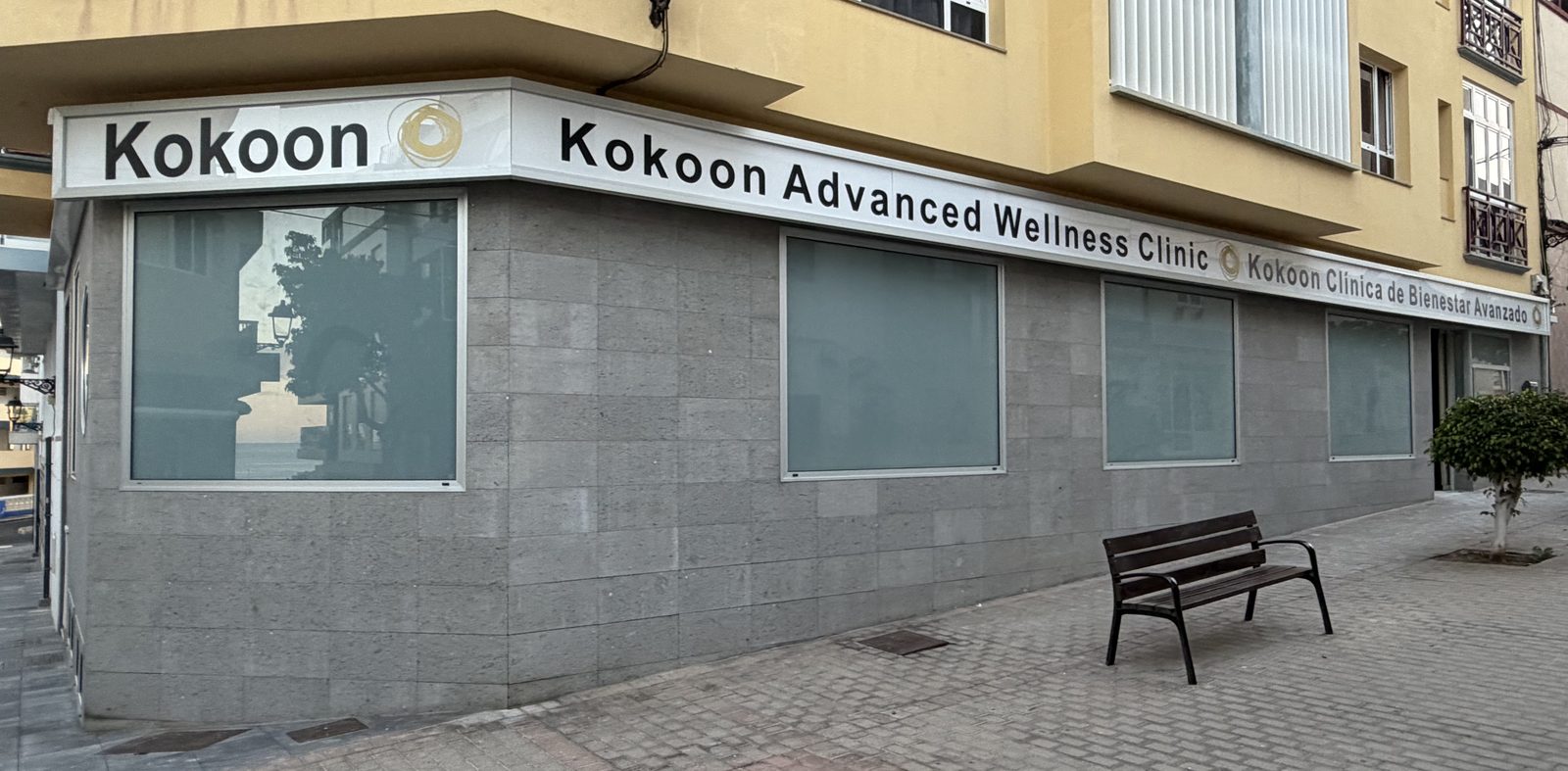
There is a particular kind of morning on the south coast of Gran Canaria, where the Atlantic sits close and Europe’s winter feels far away. If you have only heard the name Kokoon, the clearest way to understand it is to go to Arguineguín, not to a rendering or a slide deck, but to two streets in a town where people already spend the winter and the light stays long.
The first door is at Calle José Clavijo y Fajardo 3, a compact VIP clinic for recovery. The second is at Calle Ángel Guimerá 10, a larger floor that is also the registered address of the Spanish companies. Those two Advanced Wellness Clinics, owned and rebuilt by Kokoon and about to open, are what the company is today. Stand on the pavement and the picture changes, because this is no longer a company asking anyone to imagine a building. It is a company standing in front of one.
WHAT YOU WALK INTO
An Advanced Wellness Clinic brings high-tech recovery and wellness under one roof, with equipment and protocols meant to give people a real lift. Wellness and recovery come first, and licensed medical services follow when local authorisation is in place.
Clinic 1 at Calle José Clavijo y Fajardo 3 is the compact recovery door. Clinic 2 at Calle Ángel Guimerá 10 is the larger floor and the registered address of the Spanish companies.
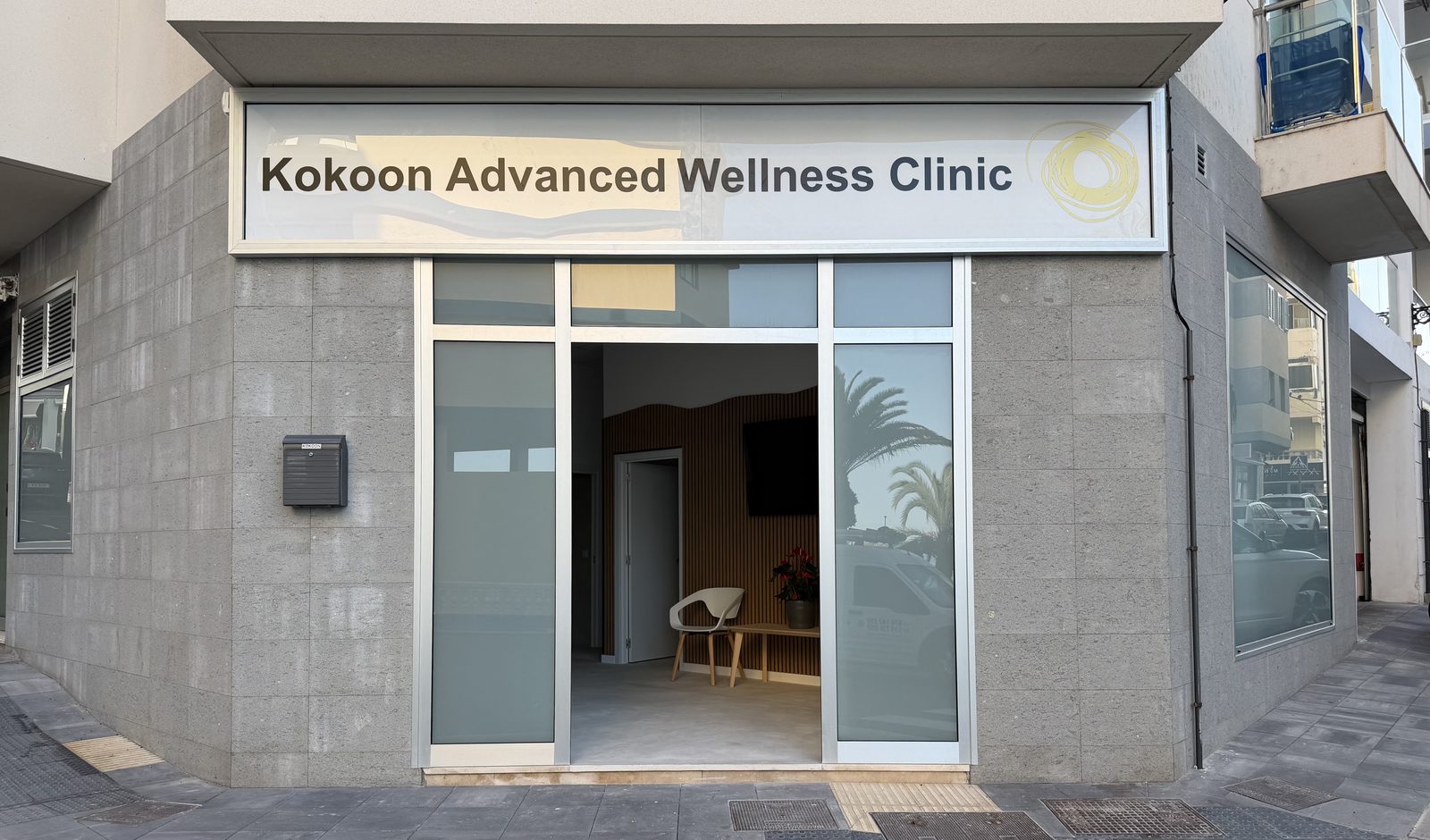
The titles sit in Kokoon Properties Spain SL, and the operations sit in Kokoon Global SL. Both companies are owned entirely by KOKOON GLOBAL PLC in the United Kingdom, and the majority holder of the PLC is Solli Holding 2 S.L., which is also registered in Arguineguín. The buildings were bought for cash, and there is no bank debt on the structure that runs these clinics.
The smaller clinic has already been on a quiet soft opening for more than a month, so the team could learn from real guests while the fit-out is finishing. When the façades go up, Kokoon stops being a name people discuss and becomes a place people walk into.
The first visits do not need a campaign from another continent. Gran Canaria already has professional football in Las Palmas, professional basketball in the capital, tennis and golf that run all year in the south, and families who stay when the athlete travels. The two doors in Arguineguín are built for that life as well: people who live here, train here, and want recovery on the island, not only those who arrive with the winter.
After both clinics find their daily rhythm, the next move is to buy more buildings, prove the work, and then grow.
THE METHOD THAT MAKES THE MAP POSSIBLE
The Kokoon way is not mysterious. It is a stubborn order of work that the team repeats in every city: members before bricks. A local membership base is built before the company buys and develops, so that when the numbers are right the clients are already there, not only to break even but to earn. It can look slower at the start, because most companies show you a building and hope the people come. Kokoon asks people to join first, which is safer than empty rooms standing on a loan.
Membership is a product anyone can buy when the clinic pages sell it, and income from membership has now started. That is the first operating income of this kind since the company began, which means the lights do not have to wait on a new round of shareholders.
Shares are a different door. Trading is not public: it happens on a platform the company owns, by invitation, through people the team knows, and there is no cold login to buy stock. Private trading and majority ownership are how the work stays in the hands of the people building it. Share buybacks are company policy. Twenty-five percent of net income is set aside to buy shares back from early shareholders, beginning with the people who grow membership day by day, and that work is underway.
This article describes a company and a method. It is not an offer of shares, not a prospectus, and not a forecast of returns.
The long map is three hundred clinics in three hundred cities across thirty-four countries. That is the destination, not a claim that those doors are open today. Smaller towns need more lifetime members up front, and larger markets have a different bar, but the rule does not change: members first, owned property second, and the team on the ground setting the pace. Ordinary people should own the end of the story, with no third-party debt, many shareholders, and many members.
A public listing was discussed once, though it was never about needing cash from a show. The company needed systems that could handle volume, and those systems were built in-house. The wait helped, because hiring fifty to eighty extra administrative people would have locked in old costs, while digital tools moved faster with the same workforce and tighter control. Opening two years earlier would also have meant older equipment, so waiting protected capital.
WHO IS BUILDING IT
Kokoon did not begin as a committee. It began as one founder’s idea, Per Jacob Solli’s, and then it became a team. Management works full time inside the company. More than sixty supporting team leaders worldwide work on this every day, many of them for years, with roughly two hundred more in the wider circle. They put in time and money for the same outcome and the same mission.
If you walk the work looking for a single man at a microphone, you will miss the point. The picture is operators, lawyers, clinic hands, sales leads, and people who stayed when the easy story would have been to leave.
The team still speaks of a co-founder who passed away some months ago, a friend who stood beside the founder from the very first day. At Kokoon events he said what a lot of the room already felt: we only want the best for people, and the best for the world. That line outlived him, and it is still the mission. They are not here to fight health systems, banks or insurers. They are here to build a privately run model that puts people first, including healthy food, more local farmers and fishermen, and more local production.
WHAT THE HARD YEARS TAUGHT THEM
The pandemic closed the Europe–United States corridor as the American push was ready, so that track froze. Spain locked down for months and geopolitics moved fast, but the company survived without bank debt while the core team and the wider circle worked on commission. The lesson they kept is short: no shortcuts, own the property, buy the equipment, and do not wake up afraid of a mortgage.
Most of what Kokoon does is never seen by the public. Almost all of it is quiet and spread across many countries. What people can see now is two doors opening on the south coast, and underneath those doors are years of preparation.
SAME DESTINATIONS, CLEARER ORDER
The places named from the beginning are still the plan. What changes is which door opens first, according to local demand, regulation, and the best interest of members and investors. You do not build where people are leaving. Sequence is discipline, not retreat.
Gran Canaria is home base and the prototype now, with a larger Medical Resort planned later, after the clinics prove the model. Crete, in Greece, is planned as an elite sports campus for sports medicine and sports research, with a clinic, and it will be the group’s only full sports campus. Norway holds Prime Living on its own track, with five satellite clinics later in the queue after Miami and Copenhagen. Copenhagen is planned as the European hub for satellite clinics serving Scandinavia and Central Europe, after Miami. In the United States, Miami comes first among the satellite clinics when membership and ground allow. Beverly Hills was looked at, but local conditions made Miami the smarter first step, with the larger resort path sitting beside that work: same ambition, better ground.
After Gran Canaria’s prototype the satellite order is Miami, then Copenhagen, then the Norway clinics. Prime Living remains a separate track. Mauritania and Africa sit further out: land is already held on the Mauritania track and the legal plans are done, while desert-scale water, food and nutrition wait on capital and delivery.
Prime Living in Norway and in the United States is one measure of the ambition. People need better places to live as they age, they want them, and there is too little of that kind of home. If a market asks for hundreds of thousands of homes and the plan is a fraction of that number, the plan is a slice of proven demand rather than a fantasy. Hear the need before you count the cost.
The long clinic plan remains three hundred satellite clinics in three hundred cities across thirty-four countries. That is the map, and the two doors in Arguineguín are the start.
WHY MEDICAL STAYS ON GRAN CANARIA AND SPORT GOES TO CRETE
One giant medical-and-sports complex on Gran Canaria was too large, because the island has extensive protected land and approvals at that scale were not realistic. When a site was turned down on size, the public message was that a smaller hotel and moving the sports campus off the same plot would open a path. The team resized. Medical stays on Gran Canaria at a scale the island can approve, and sport goes to Crete. New plans with the legal team fit what Gran Canaria will accept, so they adjust as the island adjusts.
Where a deal cannot meet their legal standard, they walk away. That includes an earlier building track left after years of seller delay and missing paperwork, not a licence failure on Kokoon’s side.
WATER AND ENERGY FROM THE SEA
On this coast they sit beside the Atlantic, so the planned Medical Resort is designed to make its own water and its own electricity, with the power running the desalination. The same idea is intended for later waterfront work in Africa, for waterfront Prime Living, and for a larger Miami resort. The technology exists, though delivery still depends on partners, capital, and the work on the ground.
WHAT COMES NEXT
The next work is to finish the two Arguineguín clinics, open them properly, serve members, and grow membership. After that the satellite queue moves: Miami first, Copenhagen next, then Norway’s five clinics, while Prime Living in Norway is planned on its own track.
Further out, after the clinics prove the model, the plan is a larger Medical Resort on Gran Canaria, Crete for elite sport, Miami for United States scale, and Mauritania and Africa when capital meets plans already on the table. The company intends to own its assets, its water where the sea allows, its platform, and its pace: without bank debt, invite-only on shares, open on membership, and owned by many.
THE FEELING, IF YOU LET THE FACTS STAND
There is a particular quiet that arrives when a story you were handed does not match the street in front of you. What stands there now is two owned doors, a UK parent, a Spanish holding, a membership people already buy, a buyback policy already in motion, a team of hundreds who did not leave, a founder who is still here, and a co-founder whose words the room still carries.
That is not a speech. It is a pavement in Arguineguín, and the clinics on it are opening soon.
Still here. Building the Kokoon way.